
People often ask us what makes the Adrette experience different from working with a typical custom window treatment company. There are a lot of answers to that question: the exclusive fabrics, the artisan craftsmanship, and our attention to every detail of the design and installation. But honestly, the answer we find ourselves giving most often is this: our clients become our friends.
The friendships we build are a result of our commitment to serving clients well. Our clients aren’t just looking for custom drapes or shades. They’re trying to complete their dream home design. They’ve worked hard to reach this moment, when they’re defining the look, feel, and experience of living in their home. They deserve to feel heard, and the whole experience should be joyful and fun.
It’s never just about fabrics, measurements, and materials, and because we see it that way, friendships are a natural outcome of our unique design process.
Throughout more than 25 years in this work, we've watched it happen repeatedly. A first phone call turns into a design consultation, a design consultation turns into a project, and a project turns into a relationship that carries on for years, sometimes decades.
This is a story where the friendship actually came first, of how a borrowed umbrella on a rainy afternoon in Hawaii became more than a design project. It became one of the most joyful experiences of our career.
This could only happen in Hawaii.


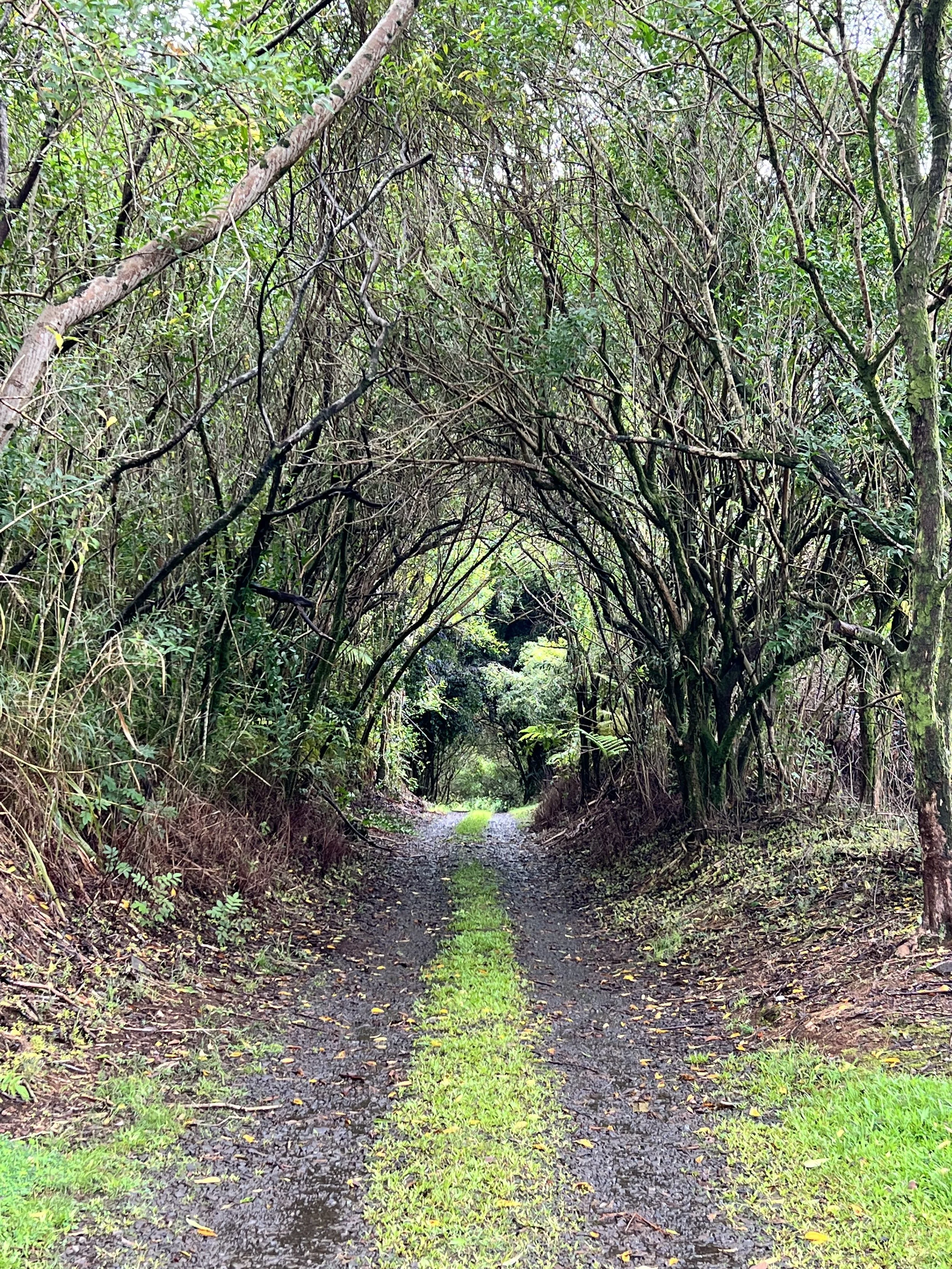
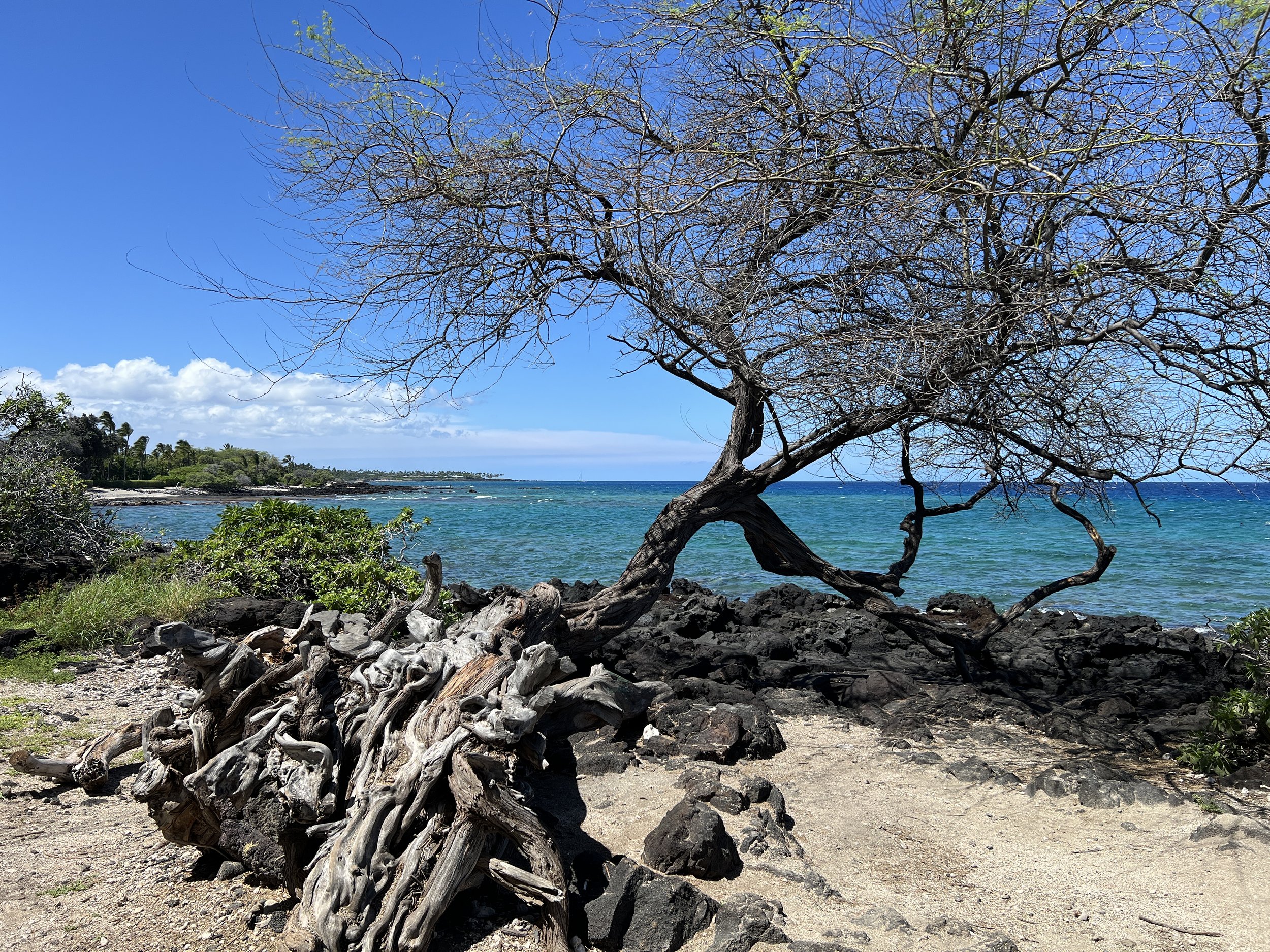
It was the spring of 2023, and we were visiting the Big Island. We were on an afternoon walk near the coastline when a friendly gentleman named Van ended up walking with us.
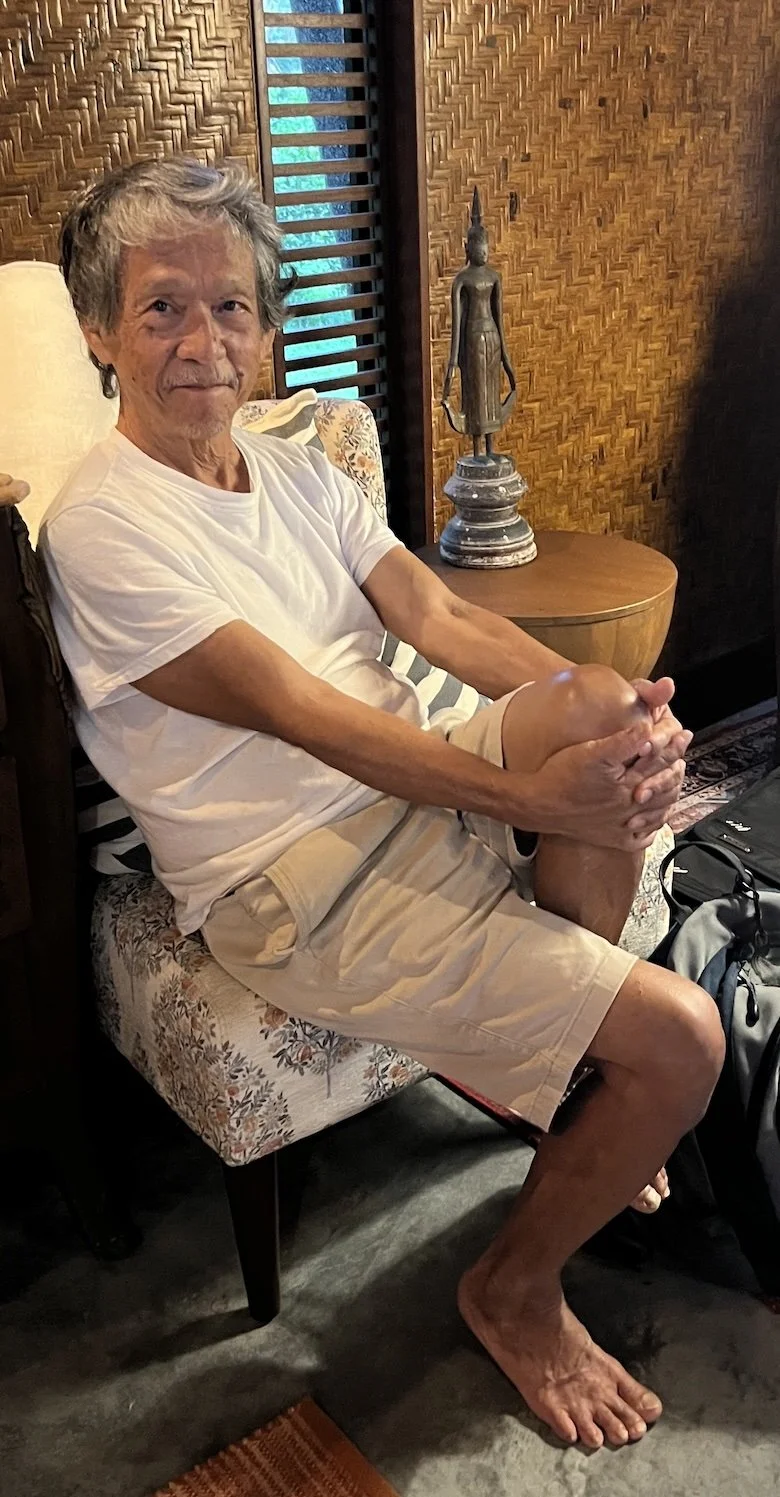
In true Aloha spirit, he welcomed us to the neighborhood and filled our afternoon with interesting conversation. He even showed us his nearly finished artist studio, a remarkable structure he had been building on his property.
When the skies opened into a downpour, Van offered us his umbrella so we wouldn't have to walk back to our Airbnb in the rain.
On our last evening in Hawaii that May, we returned the umbrella to Van's door. To our delight, we found ourselves greeted by both Van and his partner, Richard, and they welcomed us inside for a glass of wine. The four of us spent the evening in an easy, unhurried conversation about their lives, their history, and what had brought them to this quiet corner of the Big Island.
We learned that Van and Richard had lived in Los Angeles, where Van had run a florist shop which served some very interesting and famous clients. They had traded that life for a lush, stunningly landscaped property on the rainy, windward side of the island, far from the resorts and crowds.
The evening ended with a generous invitation: when their new artist studio was finished, we should come back and stay.
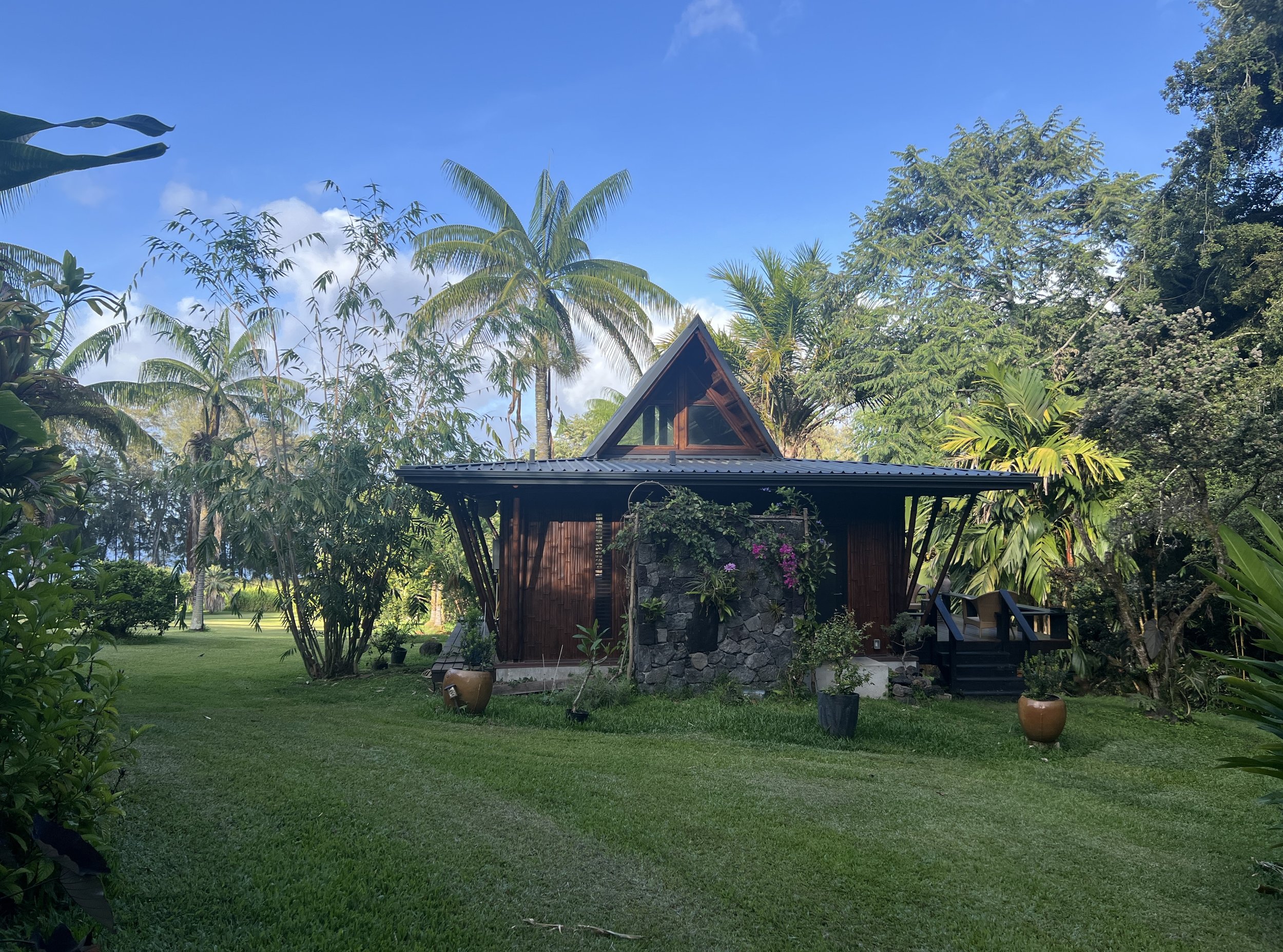
This beautiful A-frame structure was designed by Van.
The studio that stopped us in our tracks.
Nearly two years later, we took them up on that invitation and returned to The Big Island.
The studio was beautifully executed. Van, originally from Vietnam, had designed the A-frame structure and had it built in his home country before shipping it to Hawaii to be reassembled. The meticulous details and finishing touches elevate the space to a place worthy to be featured in Architectural Digest.
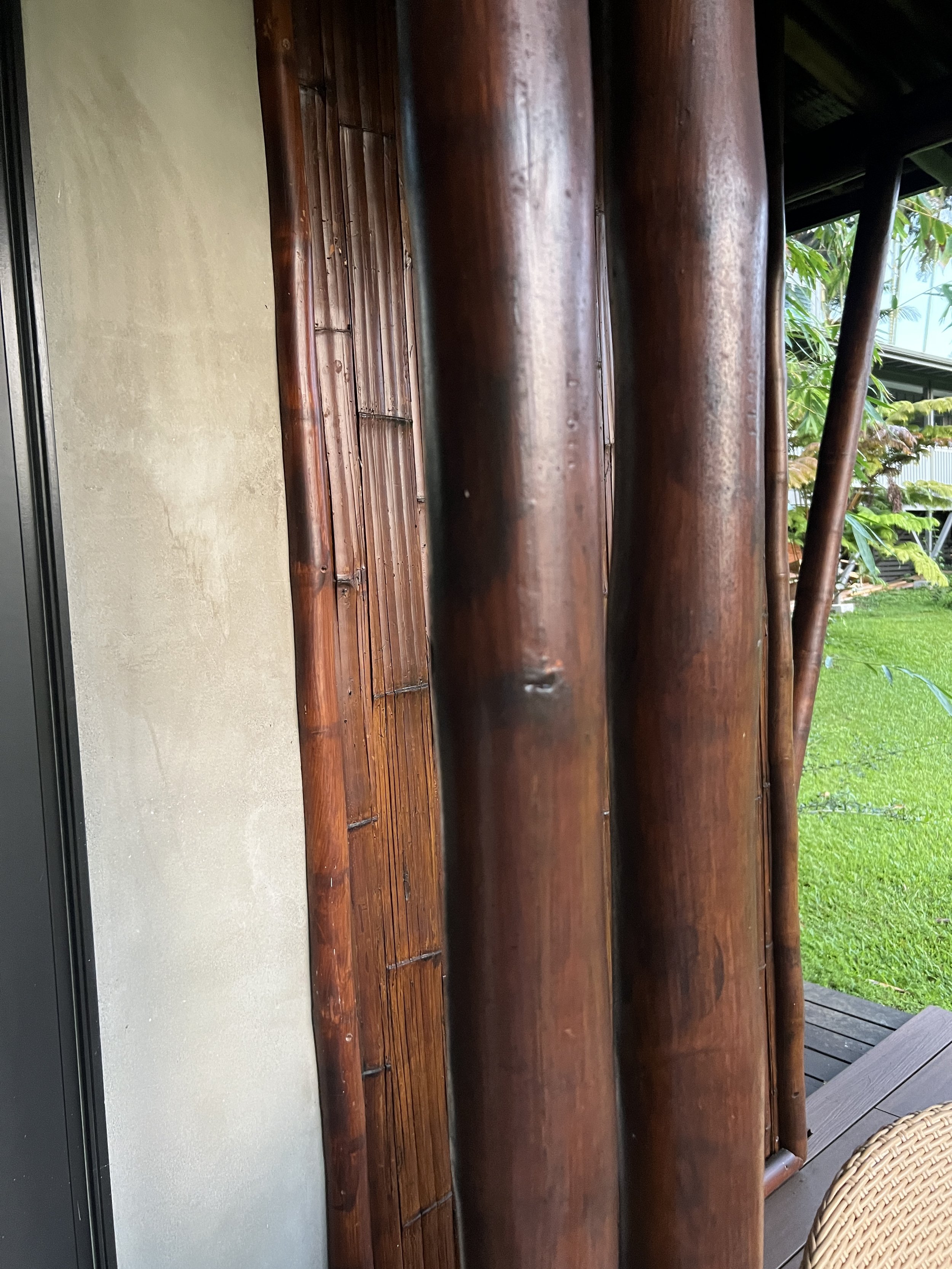
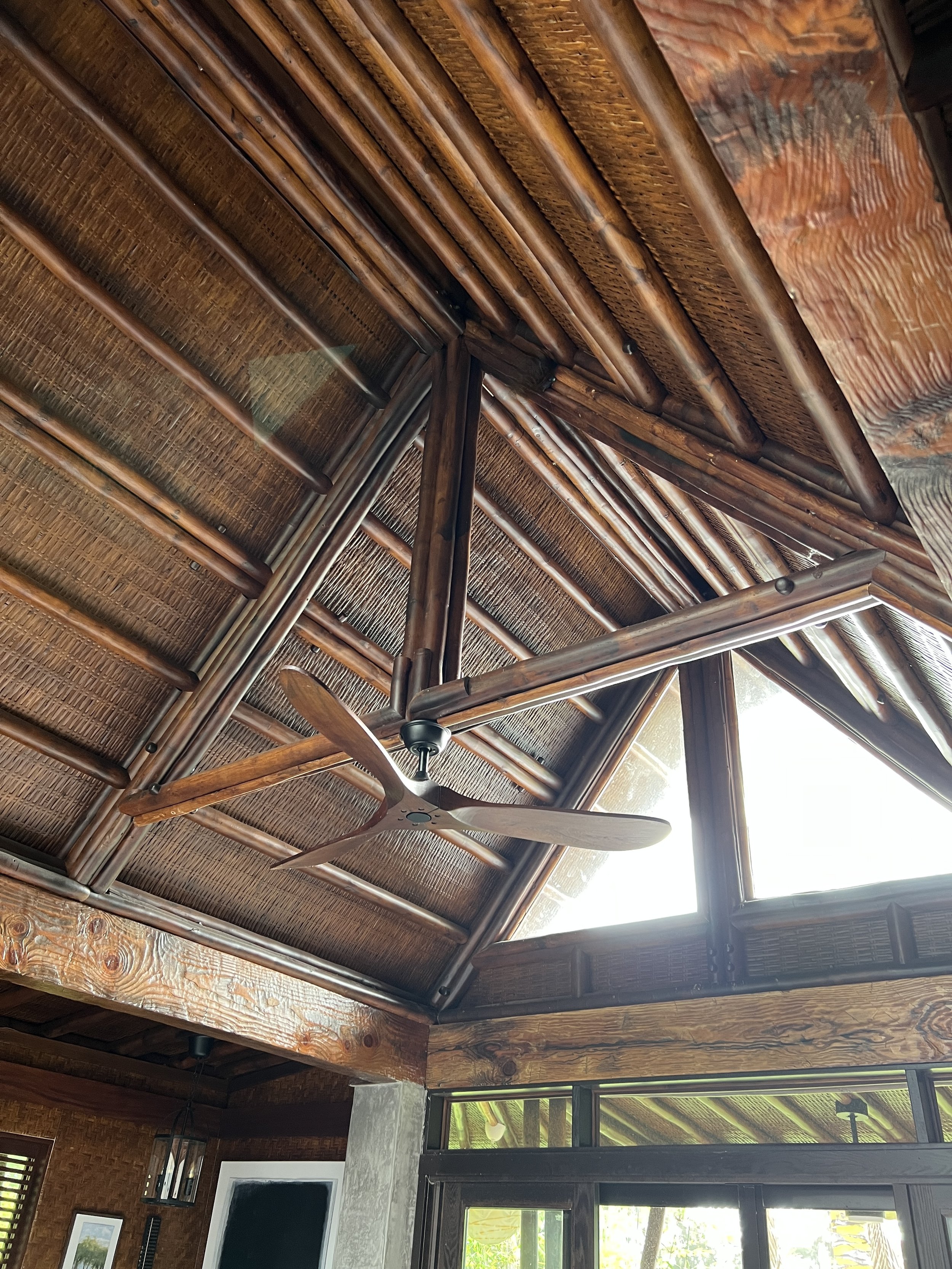
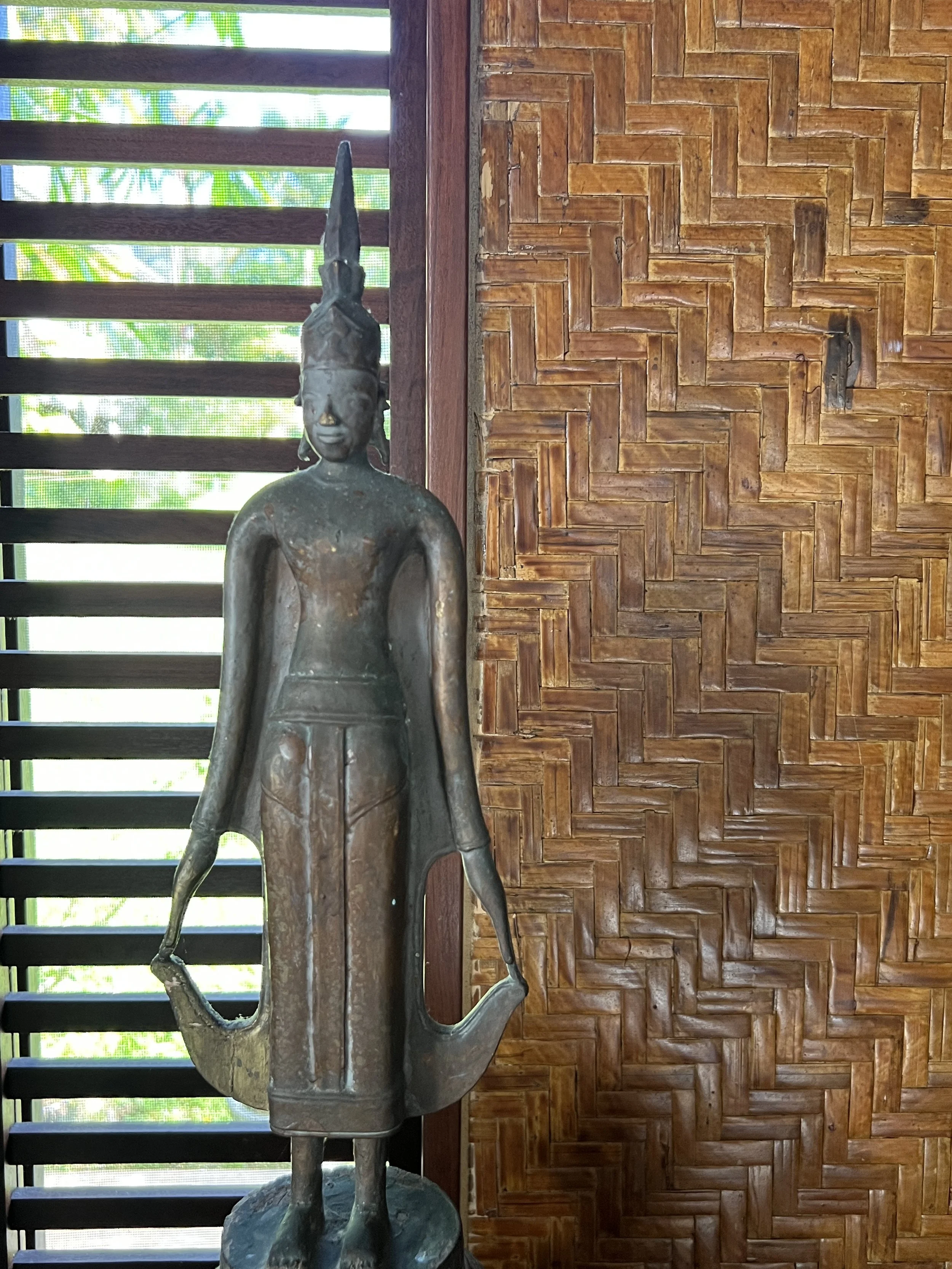
The walls are lined with woven bamboo and reed panels, giving the living space a warm, organic texture marked by precision craftsmanship. Two large, sliding doors open the space up to its surroundings. One faces the Pacific Ocean, where the view stretches to the horizon. The other greets a babbling stream that rushes down from the volcano above and finds its way to the sea.
Outside, an open-air shower is surrounded by lava rocks, and the property wraps around you like a living host - dense, fragrant, and alive with the sound of rippling water, frogs and birdsongs.
The area operates on its own quiet schedule. The sun rises early over the Pacific, and by seven in the evening, it has long since set. Richard appeared at our door the very next morning with an invitation for breakfast on their lanai. There were also slow walks through the botanical garden, peaceful mornings watching the light come up over the water, and the kind of easy company that reminds you why you stay in touch with certain people over the years.
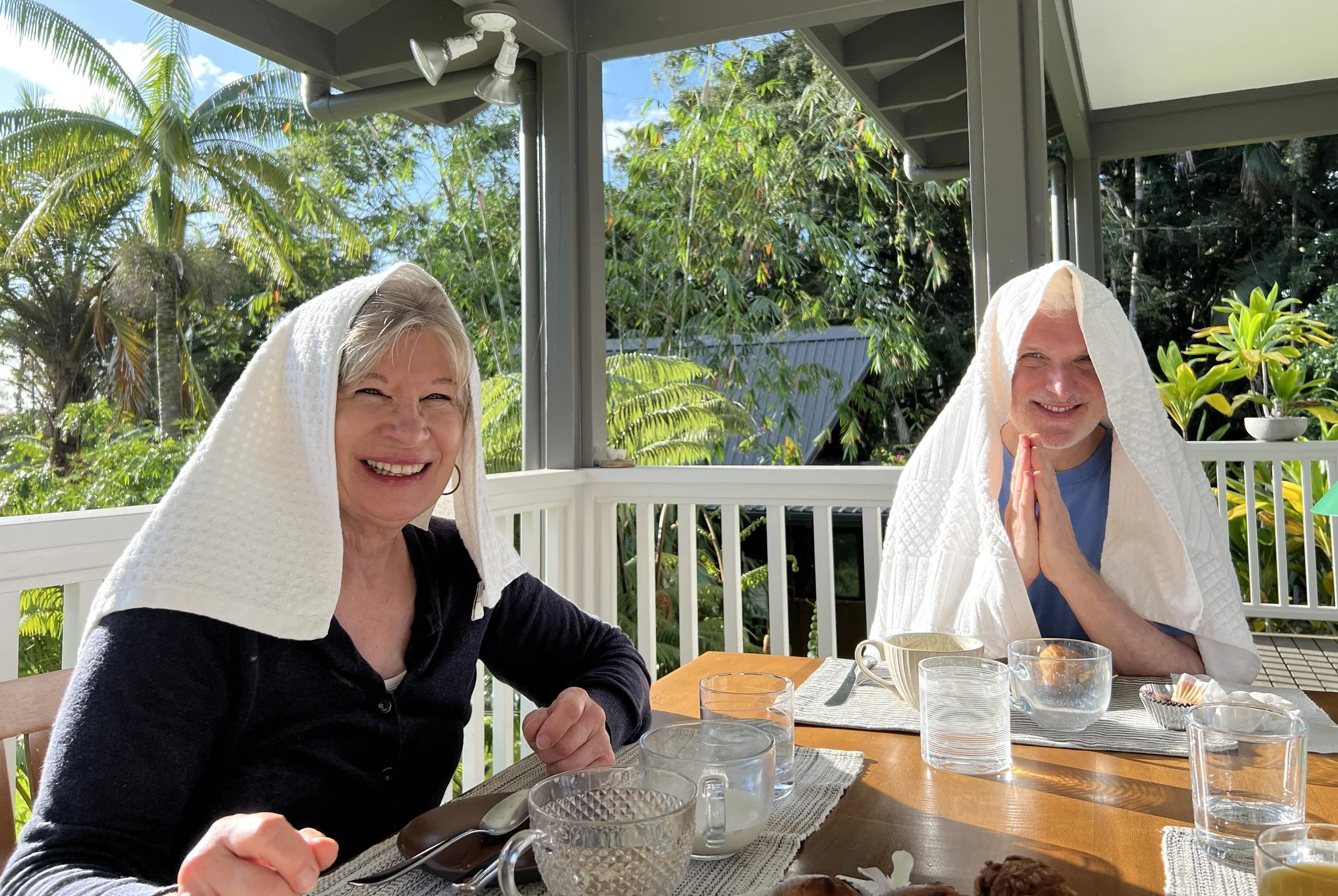
The mainlanders, Marlys and Jens, not quite used to the intense Hawaiian sun yet.
A custom window treatment design request from paradise.
It was on one of those peaceful days that Van mentioned something he'd been thinking about.
The studio was open to the world by design, but for guests staying overnight, the sliders on both sides of the studio posed some challenges. In the early morning hours, the sun rose directly in line with the ocean-facing slider, flooding the space with light. And even with the studio set well back from the main house, it needed to offer greater privacy to guests.
Knowing the work we do, Van asked whether we could design something for the two sliding doors. But he was very clear about one thing: he did not want to lose the view. Whatever we designed would need to live quietly at the sides of the sliders when open, and close gently when needed. He didn’t want anything fussy or attention-grabbing - just simple and elegant.
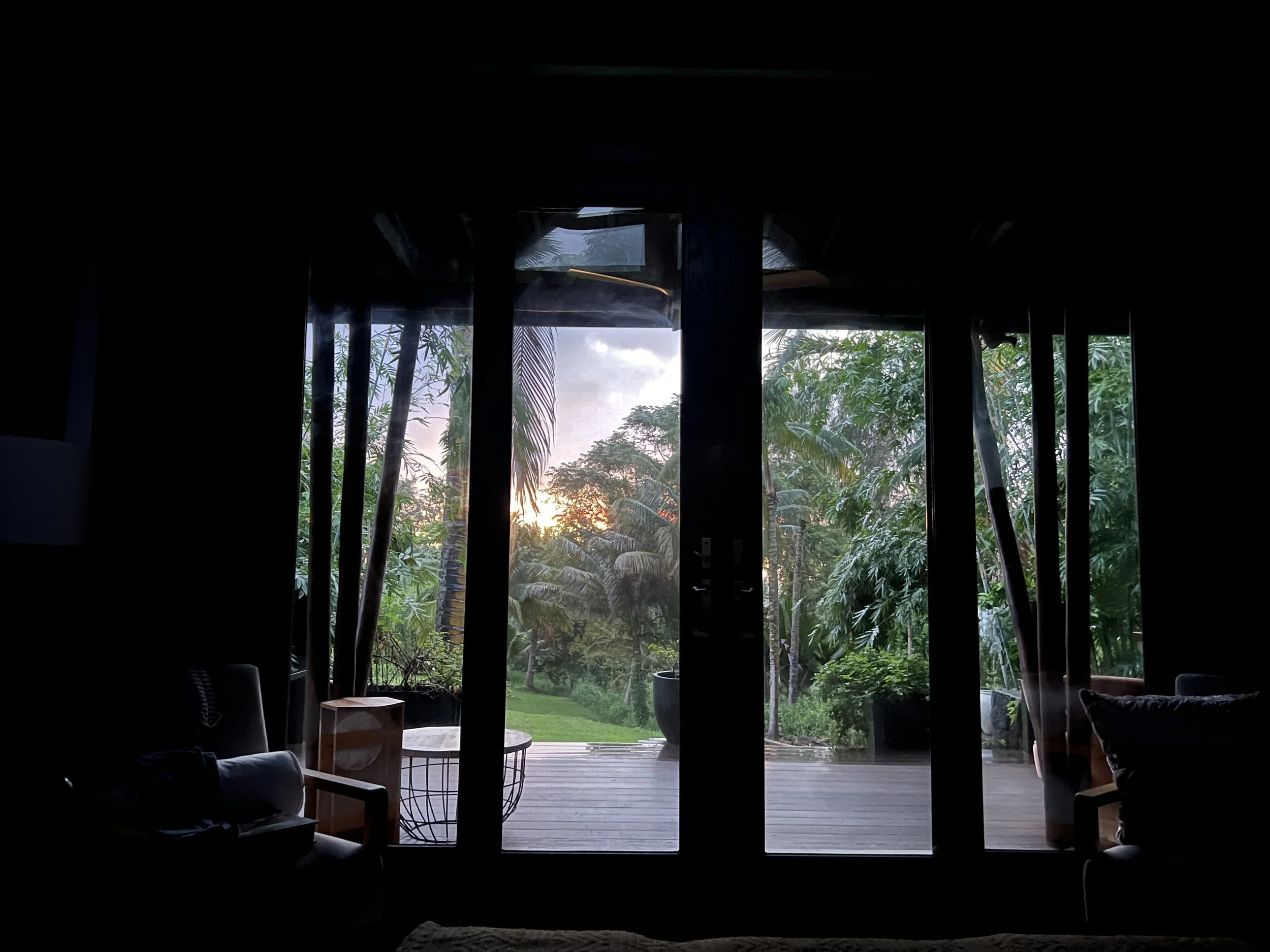
Spectacular Hawaiian sunrises begging us to awaken and get up early.
We sat with Van one afternoon and worked through the possibilities. After many iterations, we arrived at a design: a single-fold pleated, unlined drapery in a natural linen. When opened, it would stack neatly to the side, and Van would lose just one inch of window glass, a compromise he was more than happy to make.
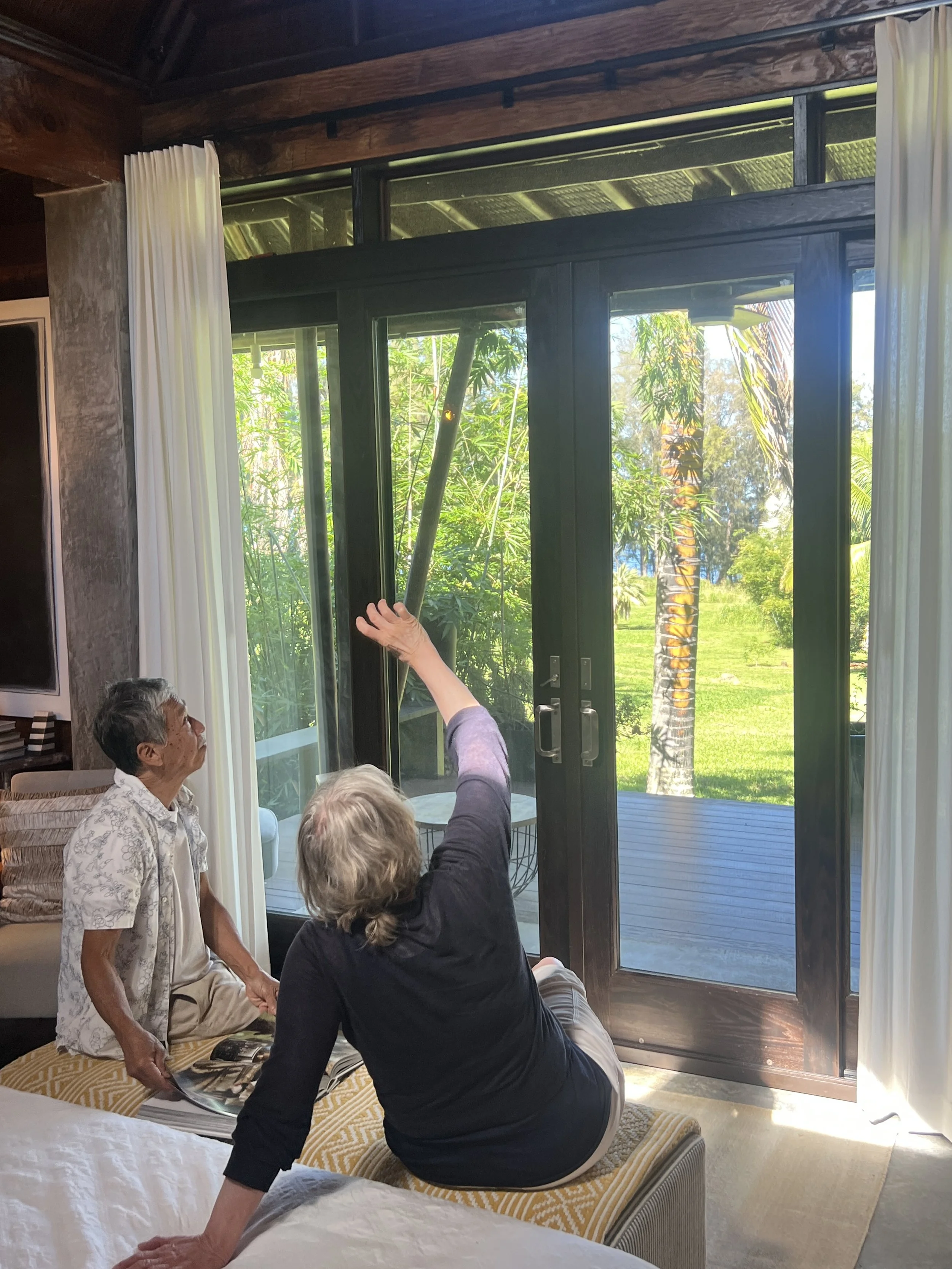
Van did not want to loose any of the view, so the drapery panels stack off to the sides.
The ocean-facing slider presented one additional consideration: it stands taller than the stream-facing door, with two triangular windows above, and the panels would need to be extended to cover the full height, making them about 12 inches longer than their counterparts across the room. We would design both sets to work together, framing each view with the same quiet, natural elegance.
For hardware, he wanted something that would disappear visually into the wooden beams and trim boards. We settled on simple black tracks, with the draperies hanging underneath, creating a minimal stack when opened.
With our design concept settled, it was time to return to “reality” back home in Oregon and start working on the details of Van and Richard’s design.
Finding the perfect window treatment fabric for a humid, Hawaiian climate
Back in Portland, we began the search for the right fabric.
We pulled several options and mailed samples to Van. After he received them, we had a video call to review the details together, and he gravitated immediately to a Pindler linen from Italy, a fabric with a soft, beautiful hand and the kind of quiet refinement the studio deserved.
But as any experienced designer will tell you, linen has a mind of its own. It is hydrophilic, meaning it attracts and absorbs moisture. Its behavior changes with the climate it lives in. In the Pacific Northwest, where our seasons move between wet and dry, we routinely see natural fiber panels grow in humid months and pull back in dry ones. The question now was how linen would behave in the humidity of Hawaii's windward coast.
To answer this question, we hung the completed panels in our Portland studio for several weeks to see if they would change length. They did not, even though it was the wettest time of the year in Oregon, but was our humidity a match for Hawaii’s?
I told Van what to expect: the linen was likely to grow in the Hawaiian climate, and we would need to account for that in the installation. We would hang them high enough to leave room for that movement, and we would watch how they settled.
Returning to Hawaii with a suitcase full of linen and a wary eye on the hemline
Jens shipped the hardware to Hawaii in advance via FedEx, making certain it would arrive safely before we did. The drapery panels, carefully folded and wrapped, traveled with us in a suitcase.
There is something that feels entirely right about that. These weren't treatments to be shipped and installed by a stranger. They were the product of a friendship, carried by hand to the people who had trusted us to transform a space that was very personal to them.
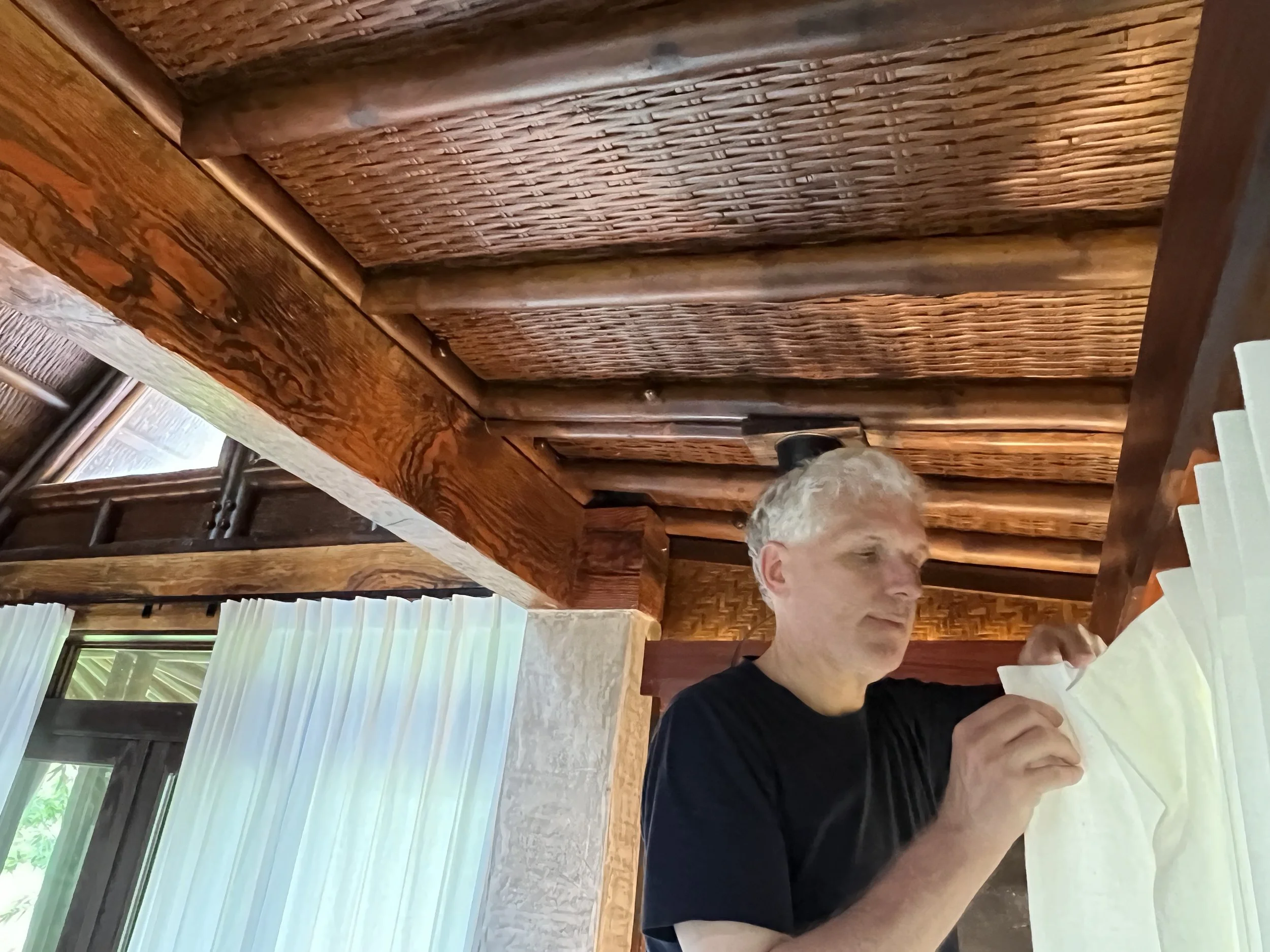
Adjusting the drapery pins.
A local drapery installer with the right ladders met us at the studio, and we got to work.
We hung the longer ocean-facing panels first. They came out of the suitcase wrinkled from the journey and needed a great deal of steaming before we could truly assess them. And as we worked, we watched them grow. The humidity was doing exactly what we knew it would. The panels that had hung perfectly stable in Portland began lengthening as they absorbed the island air.
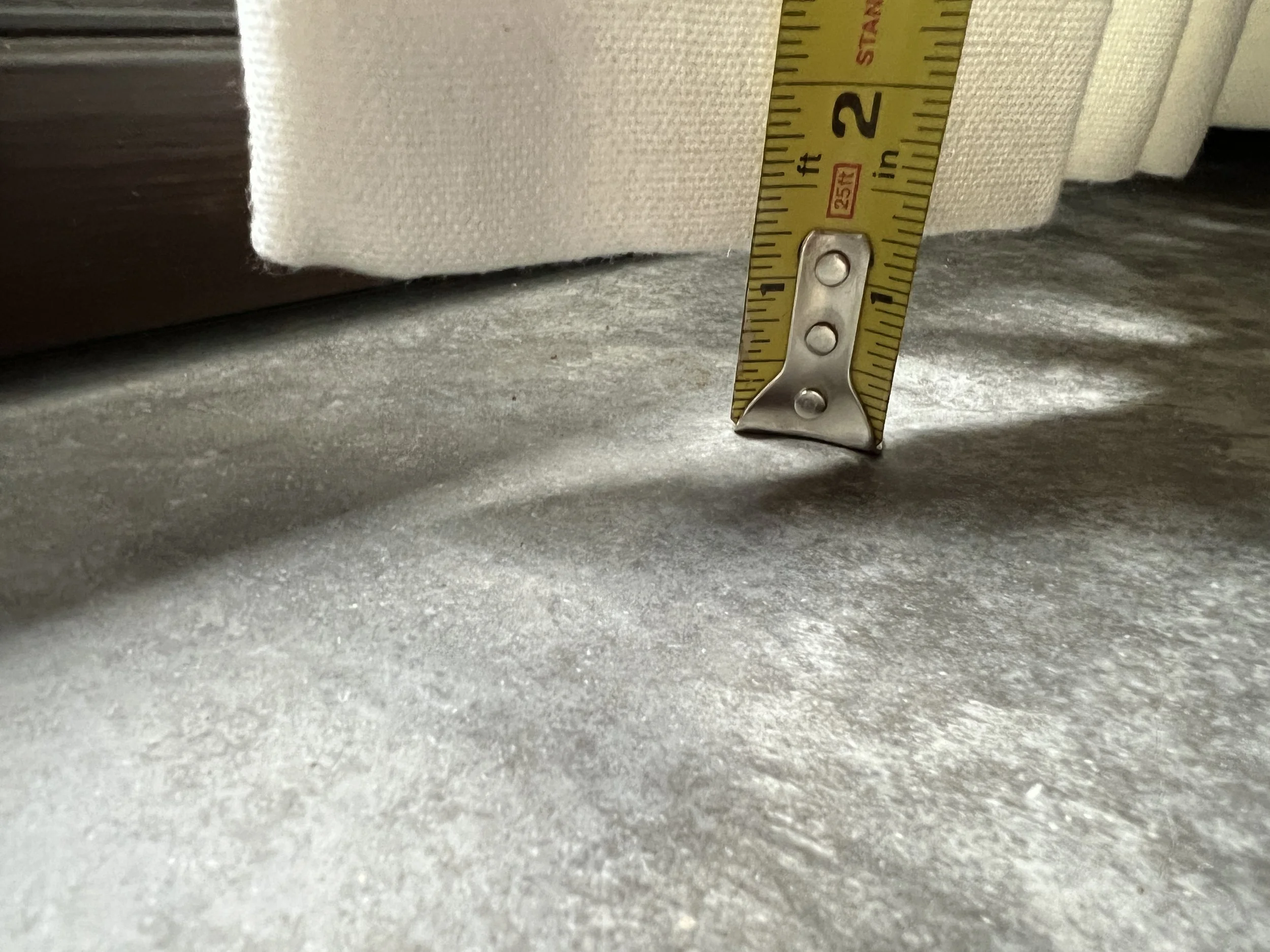
Ideally, the hemline should be about an inch off the floor.
We adjusted the rod position upward by an inch and a half. For the next 24 hours, they looked perfect.
Then they grew again.
We turned on the ceiling fan and placed a floor fan to move air across the panels, which coaxed the hemline back up to where we wanted it. Then we hung the stream-facing panels, allowing a few extra inches off the floor from the start, having already seen how the linen would behave.
The installation took about seven hours in total. We kept going back to fuss over the details: the hang of the panels, the level of the hems, the way each panel moved when the breeze came through the slider. That's the nature of this work when it matters to you.
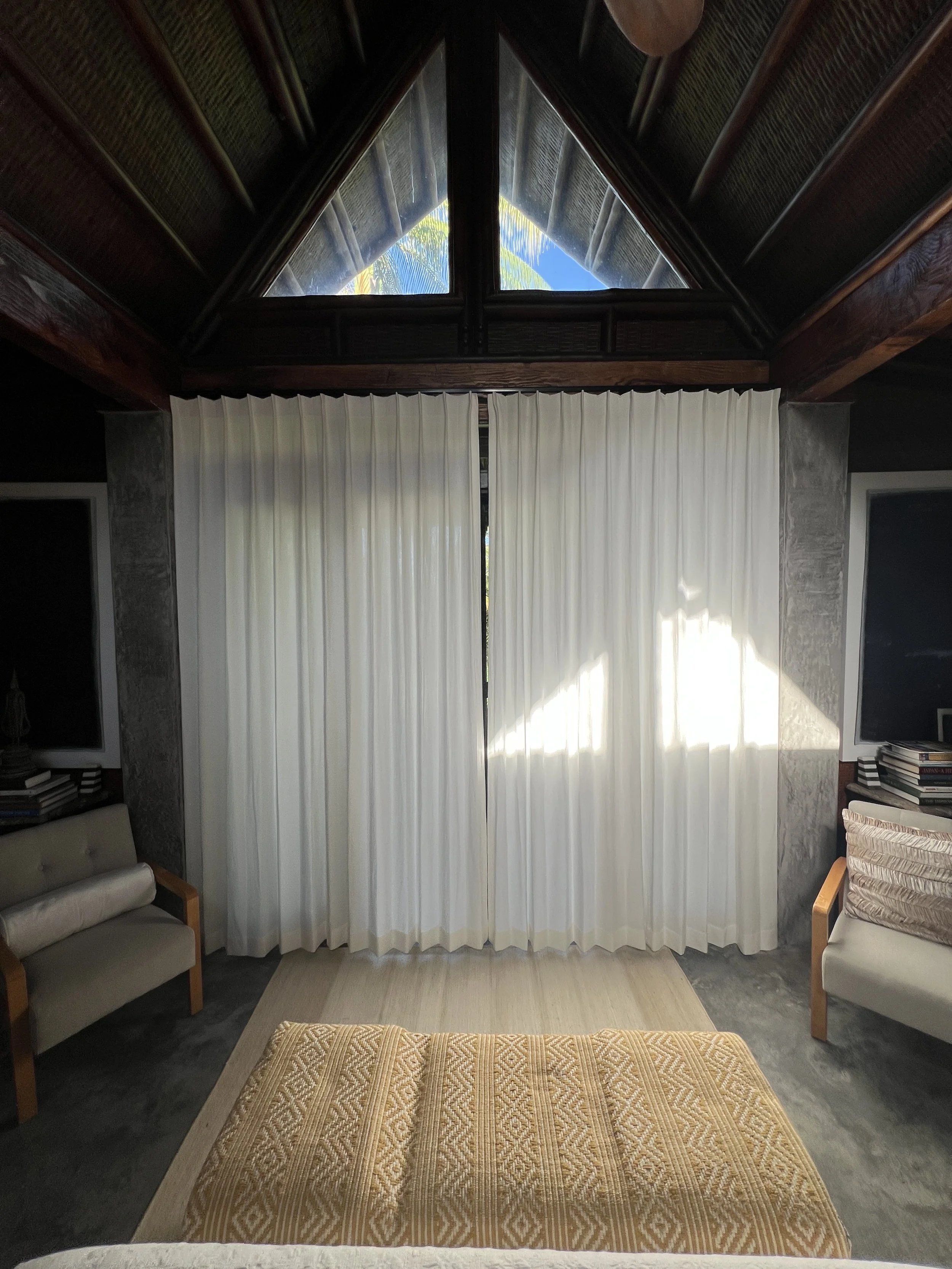
Installation complete!
The reveal of their custom drapery design and how it changed the space
When the panels were finally hanging the way we wanted them, Van and Richard came to see the result.

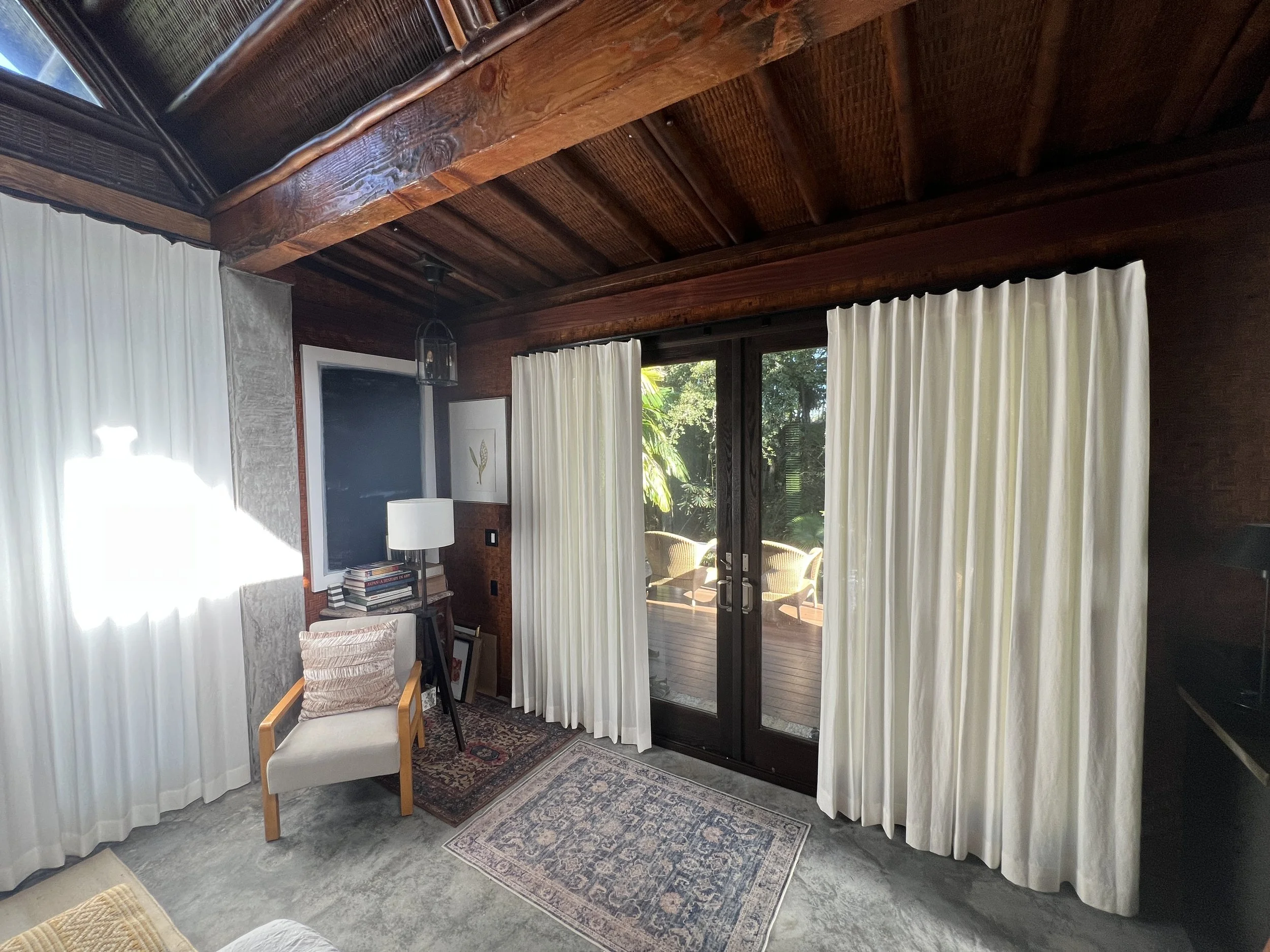
Richard commented that the vertical pleats made the room feel taller, and he was right. The single-fold pleat creates a clean line that draws the eye upward. The studio, which was already a stunning space, felt grander and more complete with the draperies in place.
Both Richard and Van were very pleased with the result. The stack on each side measured exactly 11 inches, just as planned. The stunning views were preserved, now framed in soft, luxurious linen.
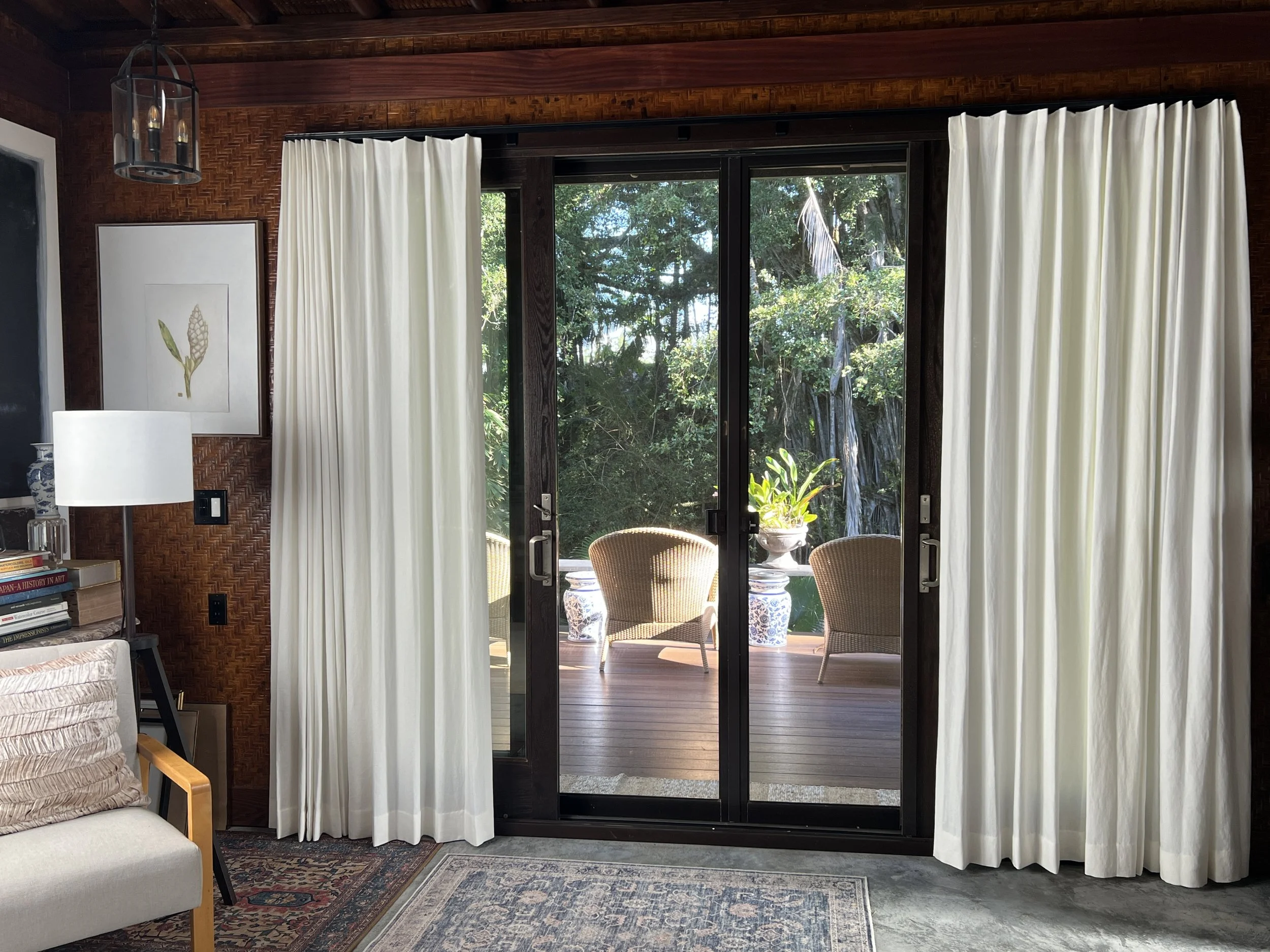
These panels frame the view toward the stream.
“As an artist with a strong interest in interior design, I am probably a challenging customer when it comes to curtain design and installation. Jens & Marlys exceeded all my expectations. They brought creativity, professionalism, patience, and genuine care to every step of the process while designing, delivering, and installing curtains for our artist studio / guest house on the Hamakua Coast of the Big Island.
They spent countless hours helping us find the perfect solution, always listening carefully and paying attention to every detail. The finished result is beautiful and exactly what we envisioned. Beyond their excellent work, their kindness and dedication made the experience truly enjoyable. After spending so much time together, we now consider Marlys and Jens our friends.”
Custom window treatment designers should deliver more than expertise.
Detailed craftsmanship and precision design are an essential part of any custom window treatment project. And yet, you deserve more.
The care that goes into a quality project - the listening, the patience, the decision to carry the panels across an ocean in a suitcase rather than trust them to a shipping company - that kind of care is what turns a client relationship into something that lasts. It's what turns a project into a friendship.
If you are ready to begin a custom window treatment project in your home and are looking for attentive, detailed care, we would be honored to be part of the journey. Schedule your free Design Discovery Call here or call us directly at 503-703-4692.
We can't wait to hear what you have in mind.
-
Yes. Linen is hydrophilic — it absorbs moisture from the air. In humid conditions, panels lengthen; in dry conditions, they draw back up. This isn't a defect; it's the nature of the fiber. A skilled installer plans for it by hanging panels with room to move and adjusting rod height as the fabric settles into its environment.
-
Linen fibers swell as they take on moisture and contract as they release it. In the Pacific Northwest, where seasons swing between wet and dry, we routinely watch natural-fiber panels grow in winter and pull back in summer. The more humid the climate, the more pronounced the movement.
-
We test first. Before an installation, we'll hang finished panels in our studio for several days to observe whether they move. Then we plan the install around the destination climate — hanging panels high enough to leave room for growth, and allowing extra clearance off the floor for natural fibers. Air movement (a ceiling- or floor fan) can also help coax a hemline back up.
-
Absolutely — this is one of the most common requests we hear. The key is designing the stack: how much wall or glass the fabric occupies when the panels are open. A single-fold pleat in an unlined fabric creates a slim, tidy stack. On a recent Hawaii project, our client lost just one inch of window glass to the open panels.
-
Choose an unlined or sheer natural fabric. Something like linen filters light rather than blocking it — the room stays bright and glare softens, but the space is no longer open to the outside. Pair it with hardware that lets panels move easily, so you can open fully when you want the view and close when you want the retreat.
-
Our home turf is Oregon — the Portland Metro area, Salem, and the Willamette Valley. Beyond that, other Pacific Northwest and destination installations are possible when our workload allows. Many of our clients become friends, and many of those friends have second homes elsewhere. When we can help, we do. The Hawaii project in this story began exactly that way.
-
It isn't a single appointment. It's a structured process designed so that, by the time anything is ordered, both you and Adrette are confident it's the right fit. Our signature process moves from a design discovery call through an on-site visit, curated fabric selection, detailed proposal, and a white-glove installation.
Complimentary Design Discovery Call — Your first conversation with Marlys. Describe your space, style, and goals, and discuss a general investment range.
Follow-Up Discovery Call — A short second call with a ballpark estimate, before we schedule an on-site visit.
Finding the Right Fit — We confirm this is the best solution for your windows and that Adrette is the right partner for your project. If it isn't, you'll know early.
One Designer, Start to Finish — Marlys is your guide and single point of contact, from first sketch to final installation.
On-Site Design Consultation — Marlys walks each room with you, identifying the right treatments and fabrics for your windows and your lighting situation.
Curated Samples & Retainer — We bring curated fabric and product samples to your home. A retainer covers this time and applies toward your purchase — the first step of your project, not a sunk cost.
Measurement & Detailed Proposal — Every window measured, and a detailed proposal covering products, fabrics, hardware, and pricing.
Ordering — Once approved, we order from our trusted vendor network, including Hunter Douglas and Insolroll.
Fabrication & Installation — Marlys oversees fabrication by our artisans and is present at the professional installation to confirm every detail matches the plan.
Follow-Up — A couple of days later, we check in to make sure everything is working — and looking — exactly as intended.
Timeline: Most blinds and shades take 4 to 6 weeks from first call to finished installation. Custom drapery, Roman shades, and bespoke bedding take roughly 10 to 12 weeks, depending on fabric availability.
One more reason to plan early if you have a remodel or move-in deadline in view.
-
Every situation is different. The Hawaii installation took about seven hours for two sliding doors — but that project was anything but typical. What's consistent is our approach: we fuss over the details until the panels hang the way they should. In most cases, our professional installer can give you a time estimate up front, including cleanup.